XVI Kaupunkifoorum Hämeenlinnassa 23.–24.9.2014

Älystä liikettä, liikkeestä kasvua

XVI kansallisen Kaupunkifoorumin teemoina ovat kasvuvyöhykkeet, asemanseudut sekä älykäs liikkuminen. Kansainvälisten ja kansallisten kärkiasiantuntijoiden johdolla pohditaan kasvukäytävien merkitystä kaupunkien kehittymisessä ja Suomessa ja muualla Euroopassa. Yhtenä keskeisenä kysymyksenä on, miten vyöhykevisiot kohtaavat arkipäiväisen vuorovaikutuksen.

Kaupunkifoorumin järjestävät yhteistyössä työ- ja elinkeinoministeriö, liikenne- ja viestintäministeriö ja Hämeenlinnan kaupunki.

Tapahtumapaikkana on Verkatehdas Hämeenlinnassa.

Foorum on kohdennettu kaupunkipolitiikan vaikuttajille eri tasoilla: kaupunkien, kuntien, valtionhallinnon ja kehittämisorganisaatioiden asiantuntijoille, yrityselämän edustajille, tutkijoille ja päätöksentekijöille.

Lue lisää ja ilmoittaudu täällä viimeistään 29.8.2014. Tutustu myös Kaupunkifoorumin ohjelmaan.

Tervetuloa!

Week 35 at Urban Mill: Aalto / RCA London Masterclass – Oppimisen ympäristöt / Labs for Learners

Kesto / Duration: 24.8. – 6.9.2014

Järjestäjä / Organizer: AALTO / Emergent Design Methodologies, RCA / Service Design

Opettajat / Teachers:
AALTO / Jarmo Suominen, Antti Ahlava, visiting lecturers (Kirsti Lonka)
RCA / Dan Phillips, Jaana Tarma, Professor Stephen Heppell

Sijainnit / Locations: Otaniemi / Urban Mill Balcony, Lontoo / RCA Service Design Studio

Kuvaus:

Kurssi on intensiivinen kahden viikon workshop, josta ensimmäinen viikko järjestetään Otaniemessä, toinen Lontoossa. Yhteistyökumppanina toimii Lontoon RCA ja kurssin opiskelijoista puolet ovat RCAn palvelumuotoilun maisteriopiskelijoita.

Kurssilla keskitytään oppimisen ympäristöjen suunnitteluun – tarkkailun, haastattelujen ja ryhmätöiden kautta – päämääränä luoda konsepteja tulevaisuuden oppimisympäristöjä varten. Lähtökohtana ”flipped classroom” ajattelu, sekä fyysisten ja digitaalisten ympäristöjen yhdistelmien mahdollisuudet.

Description:

The course is an intensive workshop, lasting two weeks – the first in Otaniemi, the second in London. Half of the students on the course will be Service Design students from the RCA of London – our partner in organizing the course.

During the two weeks, we will focus on the design of learning environments through observation, interviews and groupwork – with the aim of creating concepts for the learning environments of the future. As our starting points, we will have the ”flipped classroom” concept, and the possibilities inherent in combining digital and real spaces.

Urban Mill Open Innovation Platform Orchestration Model

Urban Mill Orchestration model was presented and discussed at ”Aalto – Nonaka Workshop: Ba & Flow in Regional Innovation Ecosystems” at Design Factory 22.8.2014.

Workshop was organized by EUE programme members in collaboration with Professor Ikurijo Nonaka and CKIR at Aalto University.  Worksghop introduced e.g. the Energizing Urban Ecosystems EUE Research School concept.

Kari Mikkelä presented their ongoing EUE research. Urban Mill Service Concept properties were reflected within the  ”Value Orchestration Platform for Business and Communities” framework introduced by prof. Kyoichi Jim Kijima.


Other topics included:

  • Professor Ikurijo Nonaka: Recent thinking and experiences on Ba & Flow
  • Markku Markkula: Special focus on the Espoo Innovation Garden as a EU forerunner. The ecosystem described and analyzed from different perspectives

Whole programme here:  Aalto-Nonaka WS 22.8.2014 programme

Tingan Tang’s PhD Thesis from Active Life Village: ”Combining User and Context: Living Labs Innovation in Digital Services”

Tingan Tang from Active Life Village team at Urban Mill presented his PhD thesis 15.8.2014:

”With the continuous advances of Information and Communication Technology (ICT) such as Ubiquitous Computing, Mobile Computing and the Internet of Things (IoT), users’ living contexts and daily life activities are increasingly digitalized. Based on these developments and other enabling factors, an emerging user- and context-driven open innovation approach called ”Living Lab” has recently gained rising popularity and momentum in both academia and industry.

As an emerging and promising innovation approach, many theoretical and empirical insights are needed to understand the dynamics of Living Labs. This thesis focuses on Living Labs innovation in the digital services domain and it addresses three aspects of Living Labs: Concept, Architecture and Methods.

The relative paucity of research on Living Labs advocates an exploratory approach that augments the research status quo with qualitative and quantitative empirical insights. The insights are gained from both a literature review and many years of Living Lab practice experiences from several Living Lab project cases in both academia and industry. The first aspect explores the Living Lab concept. A Living Lab concept framework is proposed by studying the key innovation principles of Living Lab and comparing the Living Lab principles with the corresponding Web 2.0 principles. The second aspect deals with the technical architecture of the Living Lab infrastructure. A ubiquitous Living Lab services platform is proposed and implemented by combining social media and the Web of Things. A common Living Lab technical architecture is generalized based on several Living Lab projects implementation experiences. A Web-based two-layered integration technical framework is proposed to integrate heterogeneous smart devices into business processes, and this framework is evaluated in a real-life elderly care case. The third aspect studies the methods used in Living Lab. A Living Lab process model and methods taxonomy are proposed and evaluated. Two case studies by different Living Lab methods are presented. Finally, a comparison of different Living Lab methods is summarized. The three studied Living Lab aspects are not separated from each other but intertwined in the whole Living Lab context for digital services innovation.

Overall, this thesis advances a better understanding of the Living Labs innovation paradigm.”

Publications included to thesis:

[Publication 1]: Tang, T., Wu, Z., Hämäläinen, M. and Ji, Y.. From Web 2.0 to Living Lab: an Exploration of the Evolved Innovation Principles. Journal of Emerging Technologies in Web Intelligence, VOL. 4, NO. 4, pages 379 – 385, November 2012.
[Publication 2]: Tang, T., Wu, Z., Karhu, K., Hämäläinen, M. and Ji, Y.. Internationally Distributed Living Labs and Digital Ecosystems for Fostering Local Innovations in Everyday Life. Journal of Emerging Technologies in Web Intelligence, VOL. 4, NO. 1, pages 106 – 115, February 2012.
[Publication 3]: Tang, T., Wu, Z., Hämäläinen, M. and Ji, Y.. Internationally Distributed Digital Ecosystems Infrastructure and Networked Living Labs Approach for Everyday Life Innovation. International Journal of Social Computing and Cyber-Physical Systems, Submitted, 15 pages, 2014.
[Publication 4]: Wu, Z., Itälä, T., Tang, T., Zhang, C., Ji, Y., Hämäläinen, M. and Liu, Y.. A Web-based two-layered Integration Framework for Smart Devices. EURASIP Journal on Wireless Communications and Networking, VOL. 2012, NO. 1, pages 1 – 12, April 2012. doi:10.1186/1687-1499-2012-150 View at Publisher
[Publication 5]: Tang, T. and Hämäläinen, M.. Beyond Open Innovation: the Living Labs way of ICT Innovation. Interdisciplinary Studies Journal, VOL. 3, NO. 4, pages 15 – 23, March 2014.
[Publication 6]: Tang, T. and Hämäläinen, M.. Comparison of two local social media services in Finland and China by social network analysis. International Journal of Social Network Mining, VOL. 1, NO. 2, pages 209 – 224, December 2012.
[Publication 7]: Tang, T., Cheng, C. and Hämäläinen, M.. Everyday Life Sensing by Living Lab approach. Journal of Software, VOL. 9, NO. 6, pages 1545 –1552, June 2014.

Whole: http://urn.fi/URN:ISBN:978-952-60-5741-5

Summer of Startups Demo Day 6.8. klo 17.30: esillä mm. OurNeighborhood -palvelu

KUTSU

Olen kehittämässä yhteisöllistä kaupunkihankekehitystä tehostavaa OurNeighborhood <http://ourneighborhood.fi>  -palvelua, jonka esitin sinulle aiemmin tänä keväänä/kesänä. Olemme kehittäneet palvelua intensiivisesti Summer of Startups -ohjelmassa kesä- ja heinäkuun ajan. Esitämme kehitystyön tulokset ensi keskiviikon Demo Day -tapahtumassa Otaniemen Startup Saunassa, jonne kutsun sinut tapaamaan mielenkiintoisia ihmisiä ja seuraamaan meidän ja muiden startup-tiimien esityksiä klo 17:30 alkaen. Tarjolla virvokkeita ja naposteltavaa.

Mitä? Summer of Startups Demo Day <https://www.facebook.com/events/1459295900987881/>
Missä? Startup Sauna <http://startupsauna.com/about/#space> , Betonimiehenkuja 3D, Otaniemi, Espoo
Milloin? Keskiviikko 6.8. klo 17:30 alkaen

Tervetuloa!

Joakim / OurNeighborhood

http://www.ourneighborhood.fi <http://www.ourneighborhood.fi>
https://www.facebook.com/OurNghbrhd

instagram.com/ournghbrhd <http://instagram.com/ournghbrhd>

—–

INVITATION

I have presented to you OurNeighborhood <
http://ourneighborhood.fi>  (a service for community based building and neighborhood planning) earlier this year. Our team has developed the service at the Summer of Startups program in Otaniemi during June and July and we will present the results at the Demo Day event next Wednesday. I’m happy to invite you to meet interesting people and see all teams presenting starting at 17:30. There will be drinks and snacks as well.

What? Summer of Startups Demo Day <https://www.facebook.com/events/1459295900987881/>
Where? Startup Sauna <
http://startupsauna.com/about/#space> , Betonimiehenkuja 3D, Otaniemi, Espoo
When? Wednesday 6 August, 17:30 and onwards

Welcome!

Joakim / OurNeighborhood

http://www.ourneighborhood.fi <http://www.ourneighborhood.fi>
https://www.facebook.com/OurNghbrhd

instagram.com/ournghbrhd <http://instagram.com/ournghbrhd>


Intrusion detection in the 3D space demo at Urban Mill

The intrusion detection in the 3D space function provided by XTrust and built within the D-SenS project is shown as a live and permament demo till the end of august 2014 at the Urban Mill.

The intrusion detection in the 3D space application has been thought principally for asset protection, but its presence at the Urban Mill may sugggest different applications, for instance in the area of safety. Urban Mill brings togheter the research and innovation actors of built environment development, ubiquitous & responsive city ICT, urban services and urban life transformation.

XTrust is a consortium member of the EU funded project: ”Depth Sensing Systems for People Safety”. D-SenS is a research project founded by EU for the benefit of SMEs (Small and Medium Enterprises). The D-Sens-project is aimed to provide a common technology platform together with some of the principal European research institutes. By developing more accurate and robust computer vision (CV) systems with the use of depth sensor in addition to regular cameras we aim to create some innovative but “market ready” applications.

The Project Objectives

Sensing in depth is going to be the next generation for machine vision applications. It is not just about detecting, tracking of a lot of different objects in changing environment.

Lue loppuun

Aallon innovaatio- ja yrittäjyystoiminta arvioitiin kovatasoiseksi

Aalto News 29.07.2014

Aalto-yliopisto sijoittui MIT:n 200 yliopiston vertailussa viiden nousevan yliopiston joukkoon.

Innovaatio- ja yrittäjyystoimintaa tarjoavien yliopistojen menestystä arvioi amerikkalainen Massachusetts Institute of Technology, MIT. Aalto-yliopiston menestystekijöiksi arvioitiin lahjakkaiden yksilöiden johtama tasa-arvoinen ja ruohonjuuritason työ, vahva startup-yrittäjyyttä tukeva ilmapiiri ja Aalto-yliopiston ylimmän johdon tuki.

‒ On hienoa, että Suomessa ja Aallossa tehty hyvä työ saa tunnustusta. Tähän on päästy nostamalla Aalto-yliopiston perustamisesta lähtien innovaatiotoiminta ja yrittäjyys keskeisesti mukaan koulutukseen, tutkimukseen ja yhteiskunnalliseen vaikuttamiseen koko yliopistossa, Aalto-yliopiston vararehtori Hannu Seristö iloitsee.

Vertailussa arvioitiin muun muassa yliopistojen innovaatioita tukevaa ilmapiiriä, tutkimusalueiden vahvuuksia, opiskelijoiden yrittäjyysmyönteisyyttä sekä valtion tarjoamaa tukea.

Hannu Seristö pitää opiskelijoiden uraauurtavaa työtä ja yhteistyötä yrittäjien kanssa merkittävinä kasvuyrittäjyyttä edistävinä tekijöinä.

‒ Kokeneiden yrittäjien valmennus aloitteleville yrityksille muun muassa Startup Saunassa on ollut valtavan arvokasta. Myös ministeriöt ja erityisesti Tekes ovat tukeneet toiminnan kehittämistä. Yhteispelillä on saatu erittäin hyvää aikaan, mutta tekemistä riittää vielä paljonkin. Tavoitteet ovat korkealla ja kilpailu on kovaa eikä tässä muu auta kuin juosta entistä lujempaa, Seristö jatkaa.

Aalto-yliopisto sijoittui arvioidusta 200 yliopistosta viiden ”nousevan tähden” joukkoon, jotka toimivat haasteellisissa ympäristöissä ja kykenevät avaamaa uusia teitä käytännön sovelluksille innovaatioekosysteemin kannalta vähemmän suotuisissa olosuhteissa. Tähän joukkoon lukeutuvat myös University of Auckland (Uusi-Seelanti), University of Michigan (USA), KAIST (Saudi-Arabia) ja Technion (Israel). Rankingissa korkeimmalle sijoittuivat alan kolme huippuyliopistoa, MIT (USA), Stanford University (USA) ja University of Cambridge (Iso-Britannia), jotka tunnetaan korkeatasoisesta tutkimuksesta, opetuksesta sekä maailmanlaajuisista, merkittävistä keksinnöistä. Stanfordin yliopiston kanssa Aalto-yliopisto on tehnyt jo vuosia läheistä yhteistyötä.

mit_entrepreneurship_innovation_ranking_aalto_university.png

Aalto-yliopiston panostus kasvuyrittäjyysopetukseen alkaa tuottaa hedelmää. Esimerkiksi Aalto Ventures Program (AVP) on parissa vuodessa valmentanut lähes 3000 perusopiskelijaa yrittäjyyteen.

Yliopistojen arviointi julkaistiin 25. heinäkuuta. Lue koko arviointi Creating university-based entrepreneurial ecosystems evidence from emerging world leaders (rhgraham.org, pdf-tiedosto)

Empower locally, attract globally

The natures of university core functions have evolved drastically since the majority of university facilities have been built. Yet, only a small portion of campuses have been re-engineered to meet the new demands of the network society in the middle of spatial transformation. At the same time, utilization rates and interdisciplinary synergies tend to be low. However, cases such as Design Factory, Urban Mill, Startup Sauna, ADDlab and AaltoHUBs manifest an experimental manner of executing spatial development projects. Thus, the aim of this study was to analyze processes and value generation of these five intrinsic interdisciplinary university space development projects on Aalto university campus in Otaniemi.

Results

The results propose a community-driven expansion to existing university campus management theories. The cases suggest alternative bottom-up approaches to university campus facilitation in addition to the traditional top-down facilities management and development practices. The conceptual process can be seen as an iterative loop as visualized in Figure 1. The differences are highlighted in Table 1. Moreover, new ways of learning and working seemingly require more agile, systemic, and integrated processes from facilitators in physical, social, and virtual dimensions.


PhasesHullunmylly2

Figure 1. The conceptual iterative nature of the pilot cases

PhaseDifferences

Table 1. Differences between the studied cases.

Effects

The enablers and hindrances that hopefully can help the campus managers in their complexing tasks are listed in Table 2. Common effects for the campuses deriving from this study were identified as: 1. Usability of campuses is enhanced by cross-organizational pop-in places where knowledge is thematically shared through facilitation operators; 2. Valid measures, costs, values and impacts vary in alternative environments compared to traditional institutional settings which is why the measures should be further developed; and 3. Various operational models are needed to create an interdisciplinary community – an agile follow-up project model seems to function for these cases. These notions should fundamentally affect the way in which campuses are managed.

HindrancesAndEnablers

Table 2. Enablers and hindrances of campus managers.

Future Opportunities

We hope these examples encourage university administration, facility management practitioners, university community members and researchers alike to ideate, test, implement and impact their own environments. Another question deriving from this study is how to balance between the traditional top-down and the alternative bottom-up project processes. In an attempt to find it out, another study is under construction comparing these cases with larger and more traditional projects on the same campus: the new ARTS building and Otakaari 1 renovation. After making a synthesis and a typology of these, the resulting typology can hopefully be generalized through comparing the cases with similar projects in other campuses. In the end the contribution is planned to impact both research and practice.

RYM Program

Indoor Environment

Keywords

facilitation, facility management, interdisciplinary communities, network society, pilot projects, processes, spatial transformation, University Campus Management,

Participants

Aalto University facilities services

Pilot case staff: ADF, Startup Sauna, Urban Mill, ADDlab, AaltoHUBs

BES research group and YTK: Eelis Rytkönen, Erica Österlund, Suvi Nenonen


Lue loppuun

BUILDING A SUSTAINABLE FUTURE WITH ENGINEERS, ARCHITECTS AND DESIGNERS, August 11th -14th

Sustainable Built Environment is a seminar & workshop
arranged by the school of Engineering and Arts, Design and
Architecture. In the workshops and lecture series local and
international experts and professors discuss the various
aspects of social sustainability, life cycle thinking and
architectural design. The focus is to deepen the collaboration
between the three different discipines and schools, and plan
possibilities with Finnish and international partners.

Detailed programme HERE

To enroll in the seminar, send an email by August 4th
to markku.lappalainen(at)aalto.fi


Kävellen kohti historiaa – Helsinki Walks on opiskelijoiden ja henkilökunnan yhteisponnistus

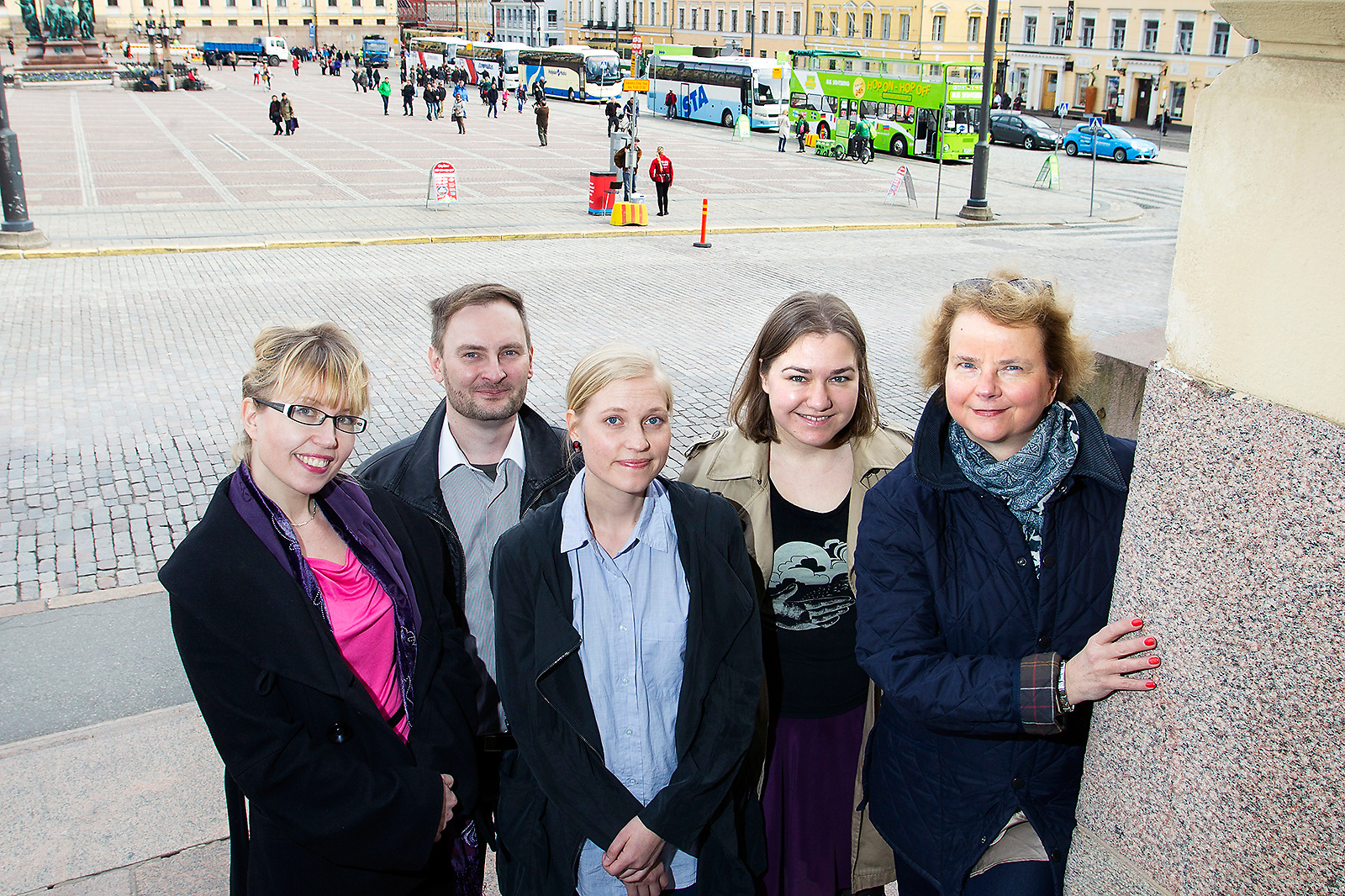
”Turistikierroksia ajavat lukuisat bussit ovat tuttu näky Helsingin Senaatintorilla. Samoille turistiapajille pyrkivällä on syytä olla puolellaan selkeä kilpailutekijä. Helsinki Walksilla omien sanojensa mukaan on.

– Keskeisin tarjottavamme on viiltävä kaupunkitutkimuksellinen asiantuntemus, Mika Mäkelä kuvailee.

Helsinki Walks valottaa tieteellisellä asiantuntemuksella Helsingin historiaa. Kuva: Linda Tammisto (blogs.helsinki.fi/helsinkithinkcompany/files/2014/06/Kolbe-Laura-team-1405-14_3_photo-HY_Linda-Tammisto.jpg)

Alun perin Helsinki Walks syntyi osana historian professori Laura Kolben “Historiasta tuotteeksi” -kurssia. Yritys järjestää historiallisia kävelykierroksia Helsingin kantakaupungin alueella. Kolbe oli vetänyt kierroksia itse vuosia ja nyt oli mahdollisuus laajentaa toimintaa yhdessä muiden kanssa.

– Tämä on samalla opetusmuoto, kansainvälistymismahdollisuus ja työllistämisen väylä opiskelijoille, Kolbe kertoo.

Yrityksessä toimii tällä hetkellä Kolben lisäksi kaupunkitutkimukseen kytkeytyvien alojen maisteri- ja jatko-opiskelijoita. Osakkaina on historian- ja kaupunkitutkimuksen asiantuntijoita. Yrityksellä on vahva yhteiskunnallinen missio.

– Haluamme syventää helsinkiläisten paikalliskokemusta ja toisaalta tuottaa matkailupalvelun. Meitä kiinnostaa, miten Suomi, Itämeri ja Eurooppa kietoutuvat yhteen tässä kaupungissa, Kolbe pohtii.”

 Lue koko blogikirjoitus täältä: http://blogs.helsinki.fi/helsinkithinkcompany/2014/06/04/kavellen-kohti-historiaa/