Otaniemi Walks! !

Finally “Otaniemi Walks” starts to look as it should!

otaniemiwalks

Yesterday we had the pleasure to run the first – accidental – test on Mr Lars Miikki at Urban Mill. In the past weeks, each time he would drop by ABE Cave he would always find us in some awkward stage of our experiments, typically wandering around the blinding white screens with our glasses on. This time we asked to wear the 3D glasses himself and have a preview. It was a joy to see an “outsider” react to the installation, move around it and give us a feedback.

“Otaniemi Walks” makes use of hand drawing in a 3D space. Lars wanted immediately to draw something himself, to see it animated inside the giant floating aquarium. I gave him my sketchbook, and few seconds later I got back a funny looking character signed with Lars’ artist name (he explained, he used to draw satyrical illustrations as a student). I will make it into a cameo for the “Square Scene” I am animating right now. It has been a long process, which started with interviews, and endless walks in Otaniemi, to understand changes that this part of the city and campus is going through.

Otaniemi campus is a fortress of heritage buildings, immersed in powerful natural settings; it has strong borders and a multiplicity of actors involved in a complex planning process.

From interviews, and my own experience as observer and campus student, nature emerged as a common ground, with a potential for facilitating the ongoing discussion and decision making towards sustainable strategies. Given the abundance of plans, visualizations, and architectural materials on the Otaniemi arena, I thought of contributing with something else, that would not offer ready solutions but could possibly inspire dialogue.

Everybody can relate to nature, and everybody has at least once in life held a pencil to draw. That is why I was so pleased with Lars’ reaction – he immediately responded to the installation, and he did it in an unexpected way.

There is still a lot of work to do, until “Otaniemi Walks” is open to the public, in a couple of months. The process entails a lot of hand drawings, animated into movies, which are themselves animated as a multitude of little actors in 3D space, by using Unity software (traditionally used by game developers).

“Otaniemi Walks” is a Master’s Thesis in Creative Sustainability, Urban Design, funded by the Energizing Urban Ecosystems Programme, and supervised by Aija Staffans, Trevor Harris, Sari Tähtinen, and Antti Kauppi. Antti is taking care of all the coding and technical aspects to make it possible; Sari is supporting me on the aesthetic and theoretical sides, and made me acquainted with the art of Yoshitaka Amano, one of the best discoveries of the year. Aija and Trevor are supporting me with their trust and imagination, which made this whole experience a great joy.

Going back to work now. To quote Aija: “Ahkeruus on ilomme – laiskuus intohimomme”! ! !

Elisa Andretti, Architect, MSc Candidate in Creative Sustainability, Urban Design at Aalto University
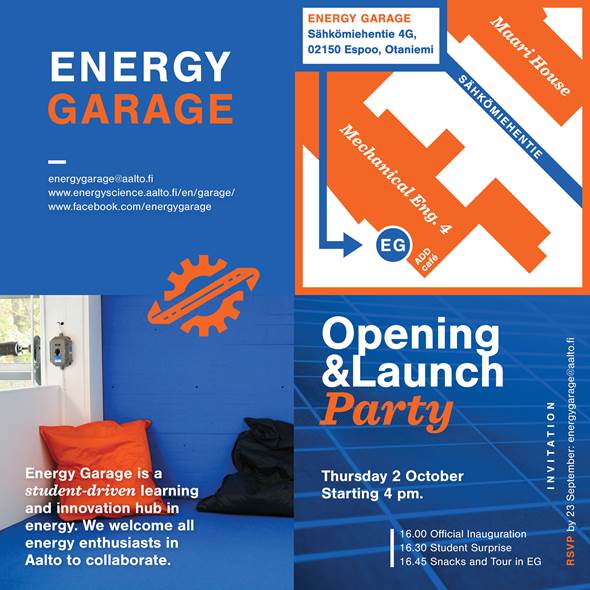
Invitation: Energy Garage Opening and Launch party Thu 2.10.2014 starting 16:00, RSVP 23.9.2014

Kuva

EnergyGarage

http://energyscience.aalto.fi/en/garage/

https://www.facebook.com/energygarage

http://physics.aalto.fi/blog/2014/02/27/energy-garage-lets-build-a-new-type-of-learning-environment/


Mailto: energygarage@aalto.fi


MEDIA LAB HELSINKI 20 years EXHIBITIONS..

In 2014 Media Lab Helsinki celebrates its anniversary with three exhibitions of current and past works by our students and researchers.

Exhibition works in Aalto Arts building & LUME centre
Hämeentie 135 C, ‘Arabia’
The exhibition at Arabia is a chronological view of some of the works made at the Media Lab Helsinki by students or researchers during the last 20 years. It includes both old classics and ongoing projects.
(Vernissage 17.9. 17-19)
Open 18.9. – 1.10. Mon-Thu 9-19, Fri 9-18.
See http://medialab.aalto.fi/20th-anniversary-exhibitions/20th-anniversary-exhibition-in-lume/

Exhibition works in Design Forum Showroom
Erottajankatu 9 B (courtyard)
The exhibition in Design Forum Showroom focuses on interesting recent works made at the Media Lab Helsinki by students or researchers.
(Vernissage 16.9. 18-20)
Open 17.9. – 1.10.2014, Mon-Fri 12-18, Sat-Sun 12-16.
See http://medialab.aalto.fi/20th-anniversary-exhibitions/20th-anniversary-exhibition-in-design-forum-showroom/

Exhibition works in Lasipalatsi Akkuna & Tovi spaces
Mannerheimintie 22-24
The exhibition at Lasipalatsi Akkuna & Tovi spaces celebrates 100 years of Finnish animation. It showcases the many ways in which Media Lab students and researchers have used animation in their projects.
(Vernissage 16.9. 17-19)
Open 17.9. – 28.9.2014, Mon-Fri 12-18, Sat-Saun 12-16.
See http://medialab.aalto.fi/20th-anniversary-exhibitions/20th-anniversary-exhibition-in-lasipalatsi/

Urban Mill Avoin Suomi 2014 -messuilla 15.-16.9.2014

Avoin Suomi 2014 -messut  Wanhassa Satamassa 15.–16.9.2014.


Urban Mill myös mukana! Seuraa tapahtumaa livenä tästä alkaen ma 15.9. klo 12.30..

Maanantain 15.9. ohjelmasisältö keskittyy avoimen tiedon mahdollisuuksiin ja vastaa kysymykseen ”Miksi avoin tieto ja sen hyödyntäminen on tärkeää?”. Tiistaina 16.9. syvennytään konkreettisten esimerkkien ja työkalujen avulla siihen ”Miten avointa tietoa voi hyödyntää?”.

Avoin tieto on

  • vapaasti saatavilla
  • uudelleenkäytettävissä
  • jatkojalostettavissa
  • jaettavissa

Tiedon avaaminen lisää yhteiskunnan läpinäkyvyyttä ja avointa toimintaa.

Urban Mill on avoin palvelu ja tila, jolla on sosiaalinen, fyysinen ja virtuaalinen muisti!

Tässä demojamme messuilla.

Messut tukevat valtioneuvoston tulevaisuusselonteon ”Kestävällä kasvulla hyvinvointia” tavoitteita. Suomi on mahdollisuuksien yhteiskunta, jossa rakennetaan avoimen tiedon liiketoimintaa ja yhteisöllisyyteen perustuvia palveluita. Julkinen sektori voi vauhdittaa kestävää kasvua tukemalla ketterää ja kokeilevaa, erilaisille ideoille avointa toimintaa.

Tervetuloa – rakenna kanssamme Avoin Suomi!

Urban Millin avoin protoilupiste löytyy päähallin perältä paikalta 14 pressihuoneen vierestä. Urbanmill@AvoinSUomi2014

KIGALI MASTER CLASS, Exhibition/Näyttely 5–26.9.2014

KIGALI MASTER CLASS
Department of Architecture, Miestentie 3
5–26.9.2014

Kigali Exhibition

During the spring term 2014, the
Department of Architecture, with the
generous support from Asko Foundation,
organized a Master Class with professor,
architect, Peter Rich.
The Master Class took students to Kigali,
Rwanda, to design a public building for an
existing need, using participatory planning
processes. Class was working at Urban Mill.
The outcomes of the Master Class
are presented in the Department of
Architecture, Miestentie 3, Espoo,
Sept. 5–26.2014, Mon-Thu 8–20, Fri 8–18.

KMC_9_2014_Juliste_Otaniemi

Kigali näyttely

Aalto-yliopiston Arkkitehtuurin laitos
järjesti keväällä 2014 maisteritason syventävän
mestarikurssin arkkitehti, professori Peter
Richin johdolla. Kurssi toteutettiin Askon
säätiön lahjoituksen turvin.

Kurssin puitteissa matkustettiin Kigaliin,
Rwandaan, tutkimaan arkkitehtuurin mahdollisuuksia
yhteisöjen kehittämisessä, jasuunnittelemaan
julkisia rakennuksia ja tiloja yhdessä paikallisten
yhteisöjen kanssa. Kurssi työskenteli Urban Millissä.

Kurssin tulokset ovat esillä Arkkitehtuurin
laitoksella, Miestentie 3, Espoo
5–26.9.2014, ma–to 8–20, pe 8–18

Urban Pioneer Valeria Gryada Nominated for Scientist of the Year Award

The designer of the Aalto Learning Hubs studied in the RYM Indoor Environment Program, Valeria Gryada is one of three candidates for the Scientist of the Year Award. The winner will be announced at the seminar of The Finnish Union of University Researchers and Teachers (FUURT) on Oct. 13, 2014.Valeria Gryada
The evolution, processes and user-centered methodology of the Aalto Learning Hub facility services network and concept have been researched in the Future Learning Environment work package of the Indoor Environment Program. Eelis Rytkönen, a researcher at RYM, and Research Manager Suvi Nenonen have been Valeria Gryada’s research partners.

“The pioneering work started by Valeria in 2011 has provided much-needed tools for implementing rapid grassroots spatial alterations and more efficient use of spaces at universities. Her inspiring and open-minded involvement of users in the design, construction and use of spaces has produced pleasant and innovative learning environments for all students of Aalto University. The Hubs have been an unqualified success based on higher utilizations rates and feedback from students,” Rytkönen and Nenonen note.

At present, ten Hubs with a total area of about 4,000 sqm are in use. The number of new potential development targets is nine. Each realized space is a prototype whose use and functionality are monitored after project completion to learn lessons useful for later projects. Cooperation between RYM and Valeria Gryada as well as monitoring of the evolution of the Learning Hub network will continue as the project moves forward.

Read more about Aalto Learning Hubs

See related result card: Empower locally, attract globally

Empower locally, attract globally

The natures of university core functions have evolved drastically since the majority of university facilities have been built. Yet, only a small portion of campuses have been re-engineered to meet the new demands of the network society in the middle of spatial transformation. At the same time, utilization rates and interdisciplinary synergies tend to be low. However, cases such as Design Factory, Urban Mill, Startup Sauna, ADDlab and AaltoHUBs manifest an experimental manner of executing spatial development projects. Thus, the aim of this study was to analyze processes and value generation of these five intrinsic interdisciplinary university space development projects on Aalto university campus in Otaniemi.

Results

The results propose a community-driven expansion to existing university campus management theories. The cases suggest alternative bottom-up approaches to university campus facilitation in addition to the traditional top-down facilities management and development practices. The conceptual process can be seen as an iterative loop as visualized in Figure 1. The differences are highlighted in Table 1. Moreover, new ways of learning and working seemingly require more agile, systemic, and integrated processes from facilitators in physical, social, and virtual dimensions.


PhasesHullunmylly2

Figure 1. The conceptual iterative nature of the pilot cases

PhaseDifferences

Table 1. Differences between the studied cases.

Effects

The enablers and hindrances that hopefully can help the campus managers in their complexing tasks are listed in Table 2. Common effects for the campuses deriving from this study were identified as: 1. Usability of campuses is enhanced by cross-organizational pop-in places where knowledge is thematically shared through facilitation operators; 2. Valid measures, costs, values and impacts vary in alternative environments compared to traditional institutional settings which is why the measures should be further developed; and 3. Various operational models are needed to create an interdisciplinary community – an agile follow-up project model seems to function for these cases. These notions should fundamentally affect the way in which campuses are managed.

HindrancesAndEnablers

Table 2. Enablers and hindrances of campus managers.

Future Opportunities

We hope these examples encourage university administration, facility management practitioners, university community members and researchers alike to ideate, test, implement and impact their own environments. Another question deriving from this study is how to balance between the traditional top-down and the alternative bottom-up project processes. In an attempt to find it out, another study is under construction comparing these cases with larger and more traditional projects on the same campus: the new ARTS building and Otakaari 1 renovation. After making a synthesis and a typology of these, the resulting typology can hopefully be generalized through comparing the cases with similar projects in other campuses. In the end the contribution is planned to impact both research and practice.

RYM Program

Indoor Environment

Keywords

facilitation, facility management, interdisciplinary communities, network society, pilot projects, processes, spatial transformation, University Campus Management,

Participants

Aalto University facilities services

Pilot case staff: ADF, Startup Sauna, Urban Mill, ADDlab, AaltoHUBs

BES research group and YTK: Eelis Rytkönen, Erica Österlund, Suvi Nenonen


Lue loppuun

Suomessa suunniteltu kapselihotelli aikoo mullistaa Helsingin majoitustilanteen

Yhteistyössä Aalto-yliopiston kanssa suunniteltu ja Urban Millissä protottu majoituskapselikonsepti  on muotoiltu vastaamaan pohjoismaisia tarpeita. Suomalainen kasvuyritys tähyää vientimarkkinoille päivittämällä japanilaisen kapselihotellikonseptin 2010-luvulle.

Kotimainen kasvuyritys Kapseli Oy tuo markkinoille modernisoidun yöpymismoduulin edulliseen hotellimajoitukseen. Yrityksen muotoilukeksintöön pohjautuvia hotellipalveluja on tarkoitus tarjota Helsingin keskustassa vuoden loppuun mennessä. Kapseli etsii nyt yhteistyökumppaneita majoitusmarkkinoiden rohkeaan uudistamiseen.

Kapseli-press 011

Suomalainen yritys on mukauttanut edullisen kapselihotellikonseptin eurooppalaisiin tarpeisiin. Yhdessä Aalto-yliopiston kanssa kehitetty majoituskapseli on muotoiltu vastaamaan pohjoismaisia tarpeita. Kotimainen yöpymismoduuli on muotoilutuote, joka puhtaanapitokeksinnön, ilmastoinnin ja äänieristyksen avulla pyrkii päivittämään Japanissa 80-luvulla yleistyneen kapselihotellimajoituksen nykypäivään.

Inspiraationi kehittää moderni majoitusmoduuli lähti tutkimusmatkastani Japanin kapselihotelleihin. Ajan hammas ei ole kohdellut Japanin halpahotelleja hyvin, mutta nykyteknologialla ja suomalaisella muotoiluosaamisella pystyimme ratkaisemaan sinänsä hyvän idean puutteet mm. ergonomiassa ja ylläpitotyössä”, yrityksen toimitusjohtaja Lilja Tamminen kertoo.

Tilapäismajoituksessa piilee mahdollinen vientituote, sillä yöpyminen ja lepo on tärkeä osa palvelukantaa kaikissa ympärivuorokautista elämää pursuavien ja kasvavien kaupunkien keskustoissa. Kapselihotellimajoitus on hyvä kilpailija hostelleille kun kuluttaja haluaa siistin, turvallisen ja yksityisen tilan levätä ja palautua arjen tai matkustamisen koettelemuksista.

Kapseli-press 017

Inspiraationi majoituslaitteen kehittämiseen ilmestyikin ensimmäisen sukupolven japanilaisten kapselihotellien keskeneräisestä toteutustavasta. Korjaamalla kapselimajoituksen ongelmat paikkaamme selkeän puutteen modernin länsimaisen kaupunkitilan palvelutarjonnassa”, toteaa Tamminen.

Kapselihotelli on vahva haastaja nuorekkaiden budjettituristien suosiota nauttiville hostelleille. Kapseli on ratkaisu omaa rauhaa etsiville sekä yöpymistä että pikaisempaa lepoa tarvitseville.

Teknologiajohtaja Teemu Pyyluoma on ylpeä yrityksen visiosta. “Hygienian ja tilankäytön ratkaisumme avartaa Aasian suurkaupunkeihin tarkoitetun pikamajoituksen pohjoismaalaiseen mukavuustasoon.”

Pyyluoma kertoo Kapseli Oy:n markkinatutkimusten osoittavan mistä kenkä puristaa majoitusbisneksessä. “Panostamalla kustannustehokkuuteen Kapselihotellin tilankäytössä ja ylläpitotyössä olemme mahdollistaneet edullisen ja siistin majoituksen kaupunkikeskustoissa. Kohderyhmämme osaavat vaatia myös varustelutasoa. Nopea nettiyhteys ja laitteiden latausmahdollisuus ovat meille itsestäänselvyys.”

Noin 28 euroa per yö Helsingin ydinkeskustassa. Uskon kuluttajien ottavan meidät vastaan kiinnostuneina”, Tamminen valottaa.

Lisätietoja antavat:

Lilja Tamminen, toimitusjohtaja, lilja(at)kapseli.eu 0402477928
Teemu Pyyluoma, teknologiajohtaja, teemu(at)kapseli.eu

http://kapseli.eu/


Kaupunkilaiset älykkään kaupungin tekijöinä

Aalto-yliopiston YTK:n johtava tutkija Aija Staffansin puheenvuoro Mapitan kesäpäivillä 2014.