Just now at Urban Mill:

Welcome to the Product Design Gala!

Are business, design, engineering or innovations close to your heart? Would you be interested to see what an interdisciplinary team can accomplish in a year together with industry partners and university mentors?
We welcome you to fall in love with the results of our interdisciplinary Product Development Project -teams in the Product Design Gala on Friday 16.5.2014
Exhibition open 9:00-17:00
Aalto Design Factory & Urban Mill
Betonimiehenkuja 5 C & 3 E Otaniemi, Espoo
The student teams from Aalto University have been working hard for the whole year to complete their design challenges given by industrial companies and other collaborating parties. In the public exhibition you’ll have the possibility to get familiar with the teams as well as with their amazing prototypes.Pictures from Thu 15.5. evening – still some work to be done!

WP_20140515_017

WP_20140515_008WP_20140515_005

This year the teams were sponsored by the following companies: ABB Marine, FIMA, Genano, KONE, Nokia, Norpe, Philips, RAY, SAKO, Vaisala and Wärtsilä. In addition student team, Bed Bug Kill, is working on their own idea and another team is collaborating with the New Children’s Hospital-project.

Schedule
09.00 Doors open – the exhibition starts!
13.00 Selected presentations @Stage
17.00 The exhibition ends

More details concerning the Gala and this year’s projects:

http://pdp.fi

PDP Gaala 2014 Press Release

See you in Gala!

Professor Kalevi “Eetu” Ekman & the whole PdP-crew
All you need is Love, Design, Business and Engineering!

Post-graduate seminar on Energy Efficient and Safe Traffic Environments – Course Launch 19.-20.5.2014 at Urban Mill

Audience: Aalto University doctoral students. The seminar project is suitable also for masters students.

Venue: The course will launch in the Cave/Kitchen at the Urban Mill.

Course description: The multi-disciplinary project seeks to develop understandings on the various aspects that play a role in the planning, construction and use of energy efficient and safe traffic environments. The seminar project is related to the Aalto Energy Efficiency (AEF) programme and it gives an overview of the areas covered in the AEF Light Energy project. The course begins with an intensive seminar which will give an appropriate grounding in order to start the individual study work. The students will meet with their assigned supervisors during the study period. The project closes with the second seminar in September. For this seminar the students are expected to prepare a written seminar work, a 20 minute presentation of his/her study, which will be followed by discussion and feedback.

PROGRAMME Lue loppuun

Active Life Village Home_As_Service_Platform Phase I Kick-off at Urban Mill 15.5.2014

Active LIfe Village’s project will produce demonstaration of ICT services at home based on broadband access connection. These services will be demostarated at Jyväskylä Asuntomessut 11.7 – 18.7.2014. Specific emphasis will be on services that will enable senior citizens live longer and happier at their homes. Demostrated concept is named:  Home-As-A_Service_Platform (HAASP). Urban Mill is one partner in this ecosystem.


Active Life Village koordinoiman hankkeen vaihe 1: Messukohde Asuntomessuille 2014 ja ”Koti palvelualustana”- konsepti

Ikääntyvien tarpeet on yksi keskeisimpiä ja nopeasti kasvavia älykkään kodin sovellusalueita, joka tarjoaa suomalaisille toimijoille mahdollisuuksia ratkaisujen kehittämiseen ja uuteen liiketoimintaan. Lisääntyvät nopeat yhteydet koteihin ja palvelukehittäminen tukevat näin toisiaan.

  • Jyväskylän asuntomessuille toteutetaan konsepti, jossa esitellään nk. älykkään kodin ratkaisuja, jotka tukevat hyvinvointia, elämisen laatua ja sujuvuutta.
  • Toteutus noudattaa ”Koti palvelualustana”-konseptia ja kohderyhmänä erityisesti ikääntyvä väestö, jolle tuodaan aktiivisen elämän, osallistumisen ja hyvinvoinnin palveluita kotiin helposti käytettäviksi. Näissä palveluissa hyvien ja edullisten tietoliikenneyhteyksien tarve korostuu, koska valtaosa elämisen aktiviteeteista tapahtuu kodin piirissä.
  • Projekti toteutetaan LVM:n sateenvarjon alla ns. yleishyödyllisenä projektina, jolloin palvelualustaa demotaan Info-standilla.
  • LVM tukee ”Koti palvelualustana”-ajattelun edistämistä ja sen tunnetuksi tekemistä nsekä Asuntomessujen (alkaen 2014) yhteydessä, että laajemmassa yhteistyössä DIGILE:n ja muiden toimijoiden kanssa kansallisen tason merkeissä. Kohteeksi valittu ikääntyvien kotona asuminen on LVM:n ohella mm. STM:n ja YM:n kiinnostuksen kohteena.

Yhteistyökonsortio: Addoz Oy, Asuntomessut Oy, Active Life Village Oy, Ilolla Oy, Playground Finland Oy, Beddit Oy, MX-Eletrix Oy, Pienipiiri Oy, Mohinet Oy, Oppimaa Oy, Trelab Oy, Anvia Oy, Urban Mill @Järvelin Design Oy, Espoon kaupunki, Pyhtään kunta, Itä-Suomen Yliopisto, LVM, Digile Oy.

Novapoint VDC Explorer julkistettiin Myllyllä 14.5.

Infra-ala on siirtymässä kovaa vauhtia tietomallintamiseen. Novapoint VDC Explorer ratkaisun avulla hankkeen kaikki osapuolet voivat heti ottaa käyttöön rakennusalalla nopeasti yleistyvät tietomallipohjaiset prosessit. Novapoint VDC Explorer on suunnittelujärjestelmäriippumaton ja mahdollistaa alalla käytössä olevien avoimien tietomallistandardien, kuten Inframodel3 ja IFC, yhdistämisen.
Novapoint VDC Explorer ratkaisun julkaisutilaisuudessa kuultiin kuinka voi saavuttaa:
  • Avointa yhteistyötä tietomallintamalla – yli organisaatiorajojen
  • Virheettömiä suunnitelmia sekä aika- ja kustannussäästöjä
  • Varmuutta ja sujuvuutta prosesseihin
  • Tyytyväisyyttä ja parempia yöunia

Ohjelma ja esitykset:

09.00 Aamupala
09.30 Ala muutoksessa – tietomallintaminen on jo täällä, Heikki Halttula
09.45 Kuinka lisäät tuottavuutta mallintamisella – tuloksia Suomesta ja maailmalta, Jani Myllymaa
10.15 Novapoint VDC Explorer  – tietomallit ja yhteistyö haltuun, Jarkko Sireeni
11.00 Tutustuminen ratkaisuun mm. Cave-3D ympäristössä, virtuaalilaseilla ja mobiililaitteilla
12:00 Tilaisuus päättyy

Novapoint VDC Explorer ohjelman pilvipohjainen kommunikointiympäristö muodostaa tietomallintamisen ja yhteistyön ytimen. Sen avulla hankkeen eri osapuolet voivat käydä vuoropuhelua yli organisaatiorajojen ja tietomalleihin tiiviisti integroituna. Tämä tuo läpinäkyvyyttä ja viiveetöntä tiedonkulkua prosesseihin.

Novapoint VDC Explorer ohjelmalla varmistetaan suunnitelmien virheettömyys ja hankkeen rakennettavuus. Usean tekniikkalajin yhdistelmämallista löydetään nopeasti päällekkäisyydet älykkään törmäyslaskennan avulla. 5D-työkalulla voidaan simuloida esim. hankkeen rakentamisen vaiheita ja löytää myös ajalliset päällekkäisyydet. Tämä tuo varmuutta ja sujuvuutta prosesseihin sekä merkittäviä kustannussäästöjä rakentamisessa.

Urban Cavessa on käytettävissä VDC Expolorerin lisenssi ja joukko esimerkkimalleja.

Ecosystem services prototyping: Urban Mill attacks on wicked problems!

Urban Mill’s pilot year 2013 focused on Platform Service prototyping. During Spring 2014 our service model development focus has shifted to Ecosystem Services.

We are aiming to answer to the question ”How Urban Mill community and it’s stakeholders could solve complex societal challenges – wicked problems – together”. And what kind of systemic development approaches, capability building processes and orchestration methods should be used?

Now the first pilot initiatives are in preparation, related e.g. to Agile University-Enterprise interfacing concepts, Espoo Innovation Garden’s RDI ecosystem services, Open regional knowledge sharing and Transition to renewable energy usages in a city context.

Methods like Goal Oriented Programme Planning (GOPP), Theory of Change (TOC), Backcasting, Design thinking, Scenario Building, Transition orchestration have been applied.

Great help for understanding our approach and philosophy gives this report:

Working with wicked problems. Guide with three approaches, five methodologies and seven rules of thumb (2012)

By publishing above report the King Baudouin Foundation (KBF) aims to facilitate knowledge sharing among all interested parties bringing together important learnings and take-away messages on working with wicked problems.

The report is based on a seminar which brought together a number of thought leaders who illuminated a palette of approaches to deal with complexity. To facilitate knowledge sharing among all interested parties, KBF requested Philippe Vandenbroeck, coordinator of the seminar, to develop an accessible and attractive report bringing together important learnings and take-away messages on working with wicked problems.

Here are some excerpts from this report:

”Acknowledging the existence of wicked problems means admitting to face societal challenges for which no definitive answer exists. Wicked problems are structurally complex so that it is hard to say where a given problem stops and another one begins. And stakeholders will frame these challenges in different ways so that a one-size-fits-all solution is highly unlikely. Thinking in terms of wicked problems opens up a novel repertoire of strategies to come to grips with these issues. However, we should guard against getting carried away by our ability to recognise and deal with complexity and conflict. Even in this complicated world ‘simple’ solutions remain possible.

What are wicked problems anyway?

When talking about the many societal challenges we are currently facing, people increasingly describe them as ‘wicked problems’. The notion has an obvious negative
resonance. Someone who is wicked is not to be trusted. We can’t really be sure
about the intentions of a wicked person. So how can a problem be ‘wicked’?

It was in the 1970s that people started to talk about ‘wicked’, ‘swampy’ or ‘messy’
problems, partly in response to the turbulence of the 1960s (remember the threat
of nuclear annihilation, the Vietnam debacle, the student revolt, the emergence
of an environmental agenda). Horst Rittel and Marvin Webber (a design theorist
and an urban planner, respectively) wrote a paper in 1973 with the forbidding title
“Dilemmas in a General Theory of Planning” in which they argued that scientific approaches to ‘problems of social policy’ were bound to fail because of the nature of these problems.

They wrote:

“They are ‘wicked’ problems, whereas science has developed to deal with ‘tame’ problems. Policy problems cannot be definitively described. Moreover, in a pluralistic society there is nothing like the undisputable public good; there is no objective definition of equity; policies that respond to social problems cannot be meaningfully correct or false; and it makes no sense to talk about ‘optimal solutions’ to social problems (…). Even worse, there are no ‘solutions’ in the sense of definitive and objective answers.”

What Rittel and Webber pointed out was that in many cases it is better to acknowledge
upfront that science is ill-equipped to tackle social challenges. There are two basic reasons for the wickedness of these problems: complexity and conflict. These problems are ambiguous and hard to pin down because they seem to consist of many partial, but interrelated challenges. So it is hard to tell what button to push, or what lever to pull to make them go away. And the people affected by these problems will have very different views on what the nature of the problem is and how it can be tackled. So, a solution that
can be considered ‘optimal’ from an objective, impartial point of view does not exist.

Key characteristics of wicked problems

  • There is no definitive formulation of
    a wicked problem. The framing of a
    wicked problem can always be contested.
  • Solutions to wicked problems are
    not true-or-false, but better or worse
    from a given point of view
  • Every attempt to intervene alters
    the problematic situation in significant
    ways.
  • Wicked problems do not have an
    enumerable set of potential solutions.
  • Every wicked problem can be considered
    to be a symptom of another problem.”

Download the whole report here.


Urban Mill — Case Study from Ilkka Kakko’s new book: Oasis Way and the Post-Normal Era — How Understanding Serendipity Will Lead You to Success

Urban Mill — Case Study: ”Urban Mill is located in Otaniemi campus in Helsinki metropolitan area. It’s the latest node of Aalto University’s ecosystem, the other main nodes being Aalto Design Factory, Start-Up Sauna and Aalto Entrepreneurship Society. The development of this ecosystem is a great example of the dynamics and life cycle thinking of communities.

The first node of the ecosystem, Design Factory, was established in 2008 and the successful transformation of the whole is based on the needs of various communities engaged. The grassroots-level activities of students are nicely combined with some institutional support of Aalto University, business community, and other stakeholders. The process of creating something like Urban Mill is a novel example of the public–private partnership. The orchestrating initiator and driver taking also an operative risk of succeeding is a private company Järvelin Design Oy, and other main stakeholders involved are Aalto University, City of Espoo, and RYM Oy (an industrial RDI consortium of urban development). This kind of setup has proved to be a dynamic foundation for the initiative and could be applied as a leading principle also in other contexts. Mr. Kari Mikkelä, Executive Producer of Urban Mill, explains the ambitious vision:

”Urban Mill is as well a co-working space, an innovation community as a change orchestration tool. Urban Mill re-defines the way, how people do joint innovation work, and aims to make societal impact in global urban context. Urban Mill facilitates to re-think how sustainable urban innovations are done, and how urban transformations are orchestrated. Thus, it channels access for its partners and stakeholders to a balanced mixture of appropriate urban innovation actors, thematic contents, collaboration methodologies and a joint development platform. The community shares one common challenge, which is how to enhance the quality of urban life and services through ICT and built environment development, and how to orchestrate and energize urban ecosystems development.”

The development process followed the principles of effectual entrepreneurship and lean start-up methodologies. The funding is mostly from the main users of the facilities, so no venture capital or direct public funding was needed. Sustainability factors are highly respected, the building is a former State Research Centre (VTT) testing laboratory facility in Otaniemi, which was transformed into a 1,300 m2 flexible co-working and co-creation space by the pioneering Urban Mill community itself. Space elements and modules are flexible and multi-usable, and open to all regardless of who is hosting the subspace. Most of the furniture, technology, resources etc. are recycled and shared among all users. Also fixed costs are shared and even some of the basic facility and special support services are co-produced on social exchange basis.

The theoretical background of the initiative is strong, the pioneering community has a widespread understanding of theories like Nonaka’s “Ba”, Kaplan & Norton’s “Strategy Maps”, Susan Star & James Griesemer’s “Boundary Objects”, Joseph Pine’s “Multiverse Framework” along with the theories of Peter Senge, Yrjö Engeström, and Manuel Castells. Figure 12 below will explain the context and main building blocks of Urban Mill approach. Kari Mikkelä describes the creation and the ongoing development of Urban Mill as “a facilitated innovation journey, where the collaborative actions and creative dialogue between different Urban Mill actors is boosted and facilitated by using physical, virtual and social boundary objects, like shared concepts, methods, probes, prototypes, demonstrations, test-beds, and living labs. Joint development work is guided by a co-created broad vision rather than by strictly pre-planned processes. Urban Mill is not only a platform for coming together, rather it is a venue to re-transform, co-align and channel its users objectives, knowledge, practices, and expected development outcomes for fitting better to the future urban life.” Figure 12: A Networked Smart Space acts as an interface between Creative Human Ecosystems and Built Environment One of Urban Mill’s innovation facilitation roles is to enable “precubation” (early stage innovation incubation) of student-led innovation. Four precubation logics have been tested during the pilot year 2013.

● Service Innovation from a University Course: In Helsinki on Tires (HoT) case group of students worked in a RDI project for the City of Helsinki as part of their PDP (Product Design Project) course studies at Aalto Design Factory. Prototypes and demonstrations of a spatial biker’s service were done using the Urban Mill spaces. After the course Urban Mill supported a 4-months extension period. During that precubation phase one of the students took a summer job and a pop-up HoT Service point was operated and tested, and further exploitation roadmaps of the service design were done together with the City Of Helsinki. The service will be implemented in 2014. http://lahioprojekti.hel.fi/ajankohtaista/helsinki-tires-final-report

● Product Innovation by University Students: In Consair Oy case two machine-design students were supported with their idea of developing a user-friendly dust-free mortar mix unit for construction companies. Early design work was done in Design Factory. Urban Mill arranged further testing and proto-building facilities for the team and supported promotion of the product towards its own industrial community. Proto sales were done for three construction companies, and test production started. http://www.consair.fi /

● Early Customer of a Product: Catchbox case is start-up offering a throwable microphone, which was invented by a student group at Design Factory. In proto phase the product was tested, e.g., in Design Factory and Startup Sauna and sold to others as a service. When CatchBox was ready for global shipping as product, Urban Mill was the first buyer of the product and helped the team, e.g., to test their selling and billing processes. Urban Mill uses Catchbox in its own events and thus promotes the product within its organizational community. http://getcatchbox.com/

● Early Customer of a Service: In BeyondGallery case a team of students developed an Art Brokerage Service during the Summer Start-ups Camp 2013 at Start-Up Sauna. Urban Mill acted as the fi rst paying customer of their art service offering. A demonstration point was then established at Urban Mill premises, where potential customers can, e.g., test Augmented Reality properties of the BeyondGallery’s service: visual art speaks at Urban Mill! http://beyondgallery.fi /

These precubaton services for the students were made possible by the support of Urban Mill’s partner community. All student teams were multi-disciplinary and highly entrepreneurial-oriented, which mentality is well supported by the Aalto University. Even though Urban Mill is still in the very beginning of the life cycle, it is interesting to discover that many of the elements of 3GSP thinking are included: 1. strong shared vision among stakeholders nurtured 2. community building in focus, engagement through “pull” factors 3. open innovation principles widely used 4. novel orchestration methodologies piloted (facilitation) 5. connectivity (local and global) supported 6. regional knowledge ecosystem thinking embedded The emergence of Urban Mill proves that novel regional knowledge ecosystems and new types of innovation intermediaries are really needed in this Post- Normal Era. When the prove of the concept has been achieved, Urban Mill concept could be tailored to new locations globally.”

Oasis Way and the Post-Normal Era — How Understanding Serendipity Will Lead You to Success

Ilkka Kakko’s new book is just published. ”Oasis Way and the Post-Normal Era — How Understanding Serendipity Will Lead You to Success examines” e.g. Urban Mill case:

”It’s interesting also to show some of the value creation process in an emergent
community. These are the working principles of Urban Mill, Otaniemi, Finland.
In a way they work as platform for the value creation, which again happens in
everyday life in the community. In this point they present the ideals and working
principles, and it’s going to be interesting to follow how they’ll transform in the
future — and will be crystallized as “real” values.

1. Doors open for all Urban pioneers (only one big theme)
2. Attract creative people, co-create meanings, make sense
3. Just start and try it! Build & Test Learn Cycle (with users)
4. Dialogue through boundary objects (physical, virtual, social)
5. Shared resources and practices, memory of the place!
6. YES, and… (instead of NO, but…)
7. Be connected, boost interactions, allow serendipity
8. Merge enthusiasm of youngsters to wisdom of seniors
9. Schools, businesses, and public bodies
10. Entrepreneurial action, effectual entrepreneurship
11. Glocal, multi-disciplinary, cross-industry activities
12. Return-on-Community (ROC) matters, space supports

As indicated above, the values and the ways that they are created may differ
a lot. The type of community (hobbyist, lead user, etc.) and the position in the life
cycle are the decisive factors. However, our experience has showed that the best
performing communities are also continuously adjusting the values. The emergent
community (like Urban Mill) has introduced values, which look more like the codes
of conduct. The underlying value generation is in Urban Mill under way and when
the community is growing rapidly, the flexible approach is needed to allow the
grassroots-level impact to be sensed.”

The digital version of the book is shared at Slide Share:

http://www.slideshare.net/ilkkakakko/new-book-ilkka-kakko-oasis-way-and-the-postnormal-era-how-understanding-serendipity-will-lead-you-to-success

KORKEAKOULUJEN RAHOITUSRATKAISUT -keskustelutilaisuus, ma 12.5.2014

Espoon Kokoomuksen Koulutusklubi järjestää

Maanantaina 12.5. klo 17 – 20
Urban Mill, Betonimiehenkuja 3 E

Puhujina ja kommentaattoreina mm.

  • rehtori emeritus Veijo HINTSANEN
  • Laurean rehtori Jouni KOSKI
  • professori emeritus Martti TIURI
  • Urban Mill Kari MIKKELÄ
  • SITRA Timo HÄMÄLÄINEN

Tilaisuuden juontaa klubin vetäjä Päivi KÄRI-ZEIN ja musiikista
vastaa Kristian MEURMAN.

Kahvitarjoilu. Tervetuloa vaikuttamaan

Espoon Kokoomus ry

Länsiväylä_7_5_ESPOO_KK_rahoitus_1

Urban Mill pioneerit voitokkaita Plootu Fennica 2014 kilpailussa!


Vuoden ohutlevytuotteksi ja kilpailun voittajaksi valittiin Footbalance Kiosk.

Kolme sarjaa, rahapalkinnot ja paljon näkyvyyttä

Plootu Fennica on ohutlevytuotteiden suunnittelukilpailu, jossa on kolme sarjaa:
teollisuus, muotoilu ja oppilaitos. Kilpailun järjestää Teknologiateollisuus ry:n Ohutlevytuotteet-toimialaryhmä. Kilpailulla haettiin jälleen uudenlaisia tuotteita, joissa
ohutlevyllä on olennainen osa muotoilussa, valmistustekniikassa, rakenteessa tai innovatiivisuudessa. Yksi kilpailusarjojen voittajista kruunattiin Vuoden ohutlevytuotteeksi ja palkittiin myös kisan huomattavimmalla rahapalkinnolla. Lisäksi tuomaristo palkitsi jokaisesta sarjasta töitä kunniamaininnoilla. Plootu 2014 voittajat

Oppilaitossarja on avoin kaikille opiskelijoille ja oppilaitoksille. Osallistua voivat joukkueet ja/tai yksittäiset opiskelijat niin korkeakouluista, yliopistoista, ammattikorkeakouluista kuin ammatillisista oppilaitoksistakin. Työn arvioinnissa kiinnitettiin huomioita ohutlevytuotteen tarpeellisuuteen, kekseliäisyyteen, rakenteeseen ja valmistustekniikkaan ulkoasua unohtamatta. Rahapalkinnon lisäksi voittajajoukkueille on tarjolla työharjoittelupaikat ohutlevyteollisuuden parissa.

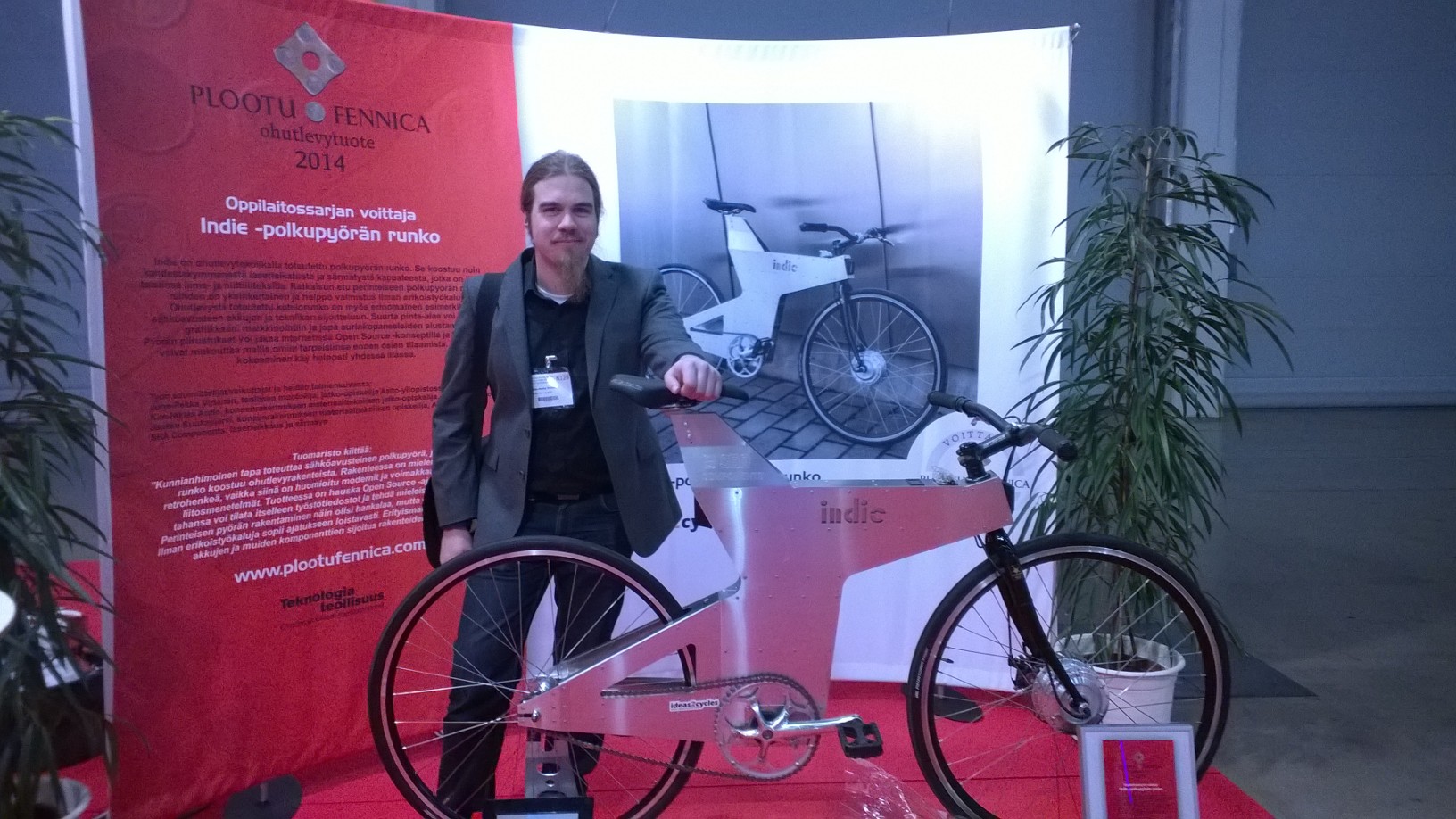
Oppilaitossarjan voittaja: Indie – polkypyörän runko

Indie on ohutlevytekniikalla toteutettu polkupyörän runko. Se koostuu noin kahdestakymmenestä laserleikatusta ja särmätystä kappaleesta, jotka on liitetty toisiinsa liima- ja niittiliitoksilla. Ratkaisun etu perinteiseen polkupyörän runkoon nähden on yksinkertainen ja helppo valmistus ilman erikoistyökaluja. Ohutlevystä toteutettu kotelorunko on myös erinomainen esimerkiksi sähköavusteen akkujen ja tekniikan sijoitteluun. Suurta pinta-alaa voi käyttää grafiikkaan, markkinointiin ja jopa aurinkopaneeleiden alustana. Pyörän piirustukset voi jakaa internetissä Open Source -konseptilla ja harrastajat voivat mukauttaa mallia omiin tarpeisiinsa ennen osien tilaamista. Rungon kokoaminen käy helposti yhdessä illassa.

JP ja pyörä Plootu FennicaJuho-Pekka Virtanen ja voittoisa pyörän runko

Tuomaristo kiittää:
”Kunnianhimoinen tapa toteuttaa sähköavusteinen polkupyörä, jonka kantavaan runko koostuu ohutlevyrakenteista. Rakenteessa on mielenkiintoista retrohenkeä, vaikka siinä on huomioitu modernit ja voimakkaasti kehittyvät liitosmenetelmät. Tuotteessa on hauska
Open Source -ajatus: kuka tahansa voi tilata itselleen työstötiedostot ja tehdä mieleisensä pyörän. Perinteisen pyörän rakentaminen näin olisi hankalaa, mutta ohutlevyn käyttö ilman erikoistyökaluja sopii ajatukseen loistavasti. Erityismaininnan ansaitsee akkujen ja muiden
komponenttien sijoitus rakenteiden sisään.”

Tiimi ja tukijat:

Juho-Pekka Virtanen, Aalto-yliopisto
Kim-Niklas Antin, Aalto-yliopisto
Jaakko Kuukasjärvi, Aalto-yliopisto
SBA Components: laserleikkaus ja särmäys

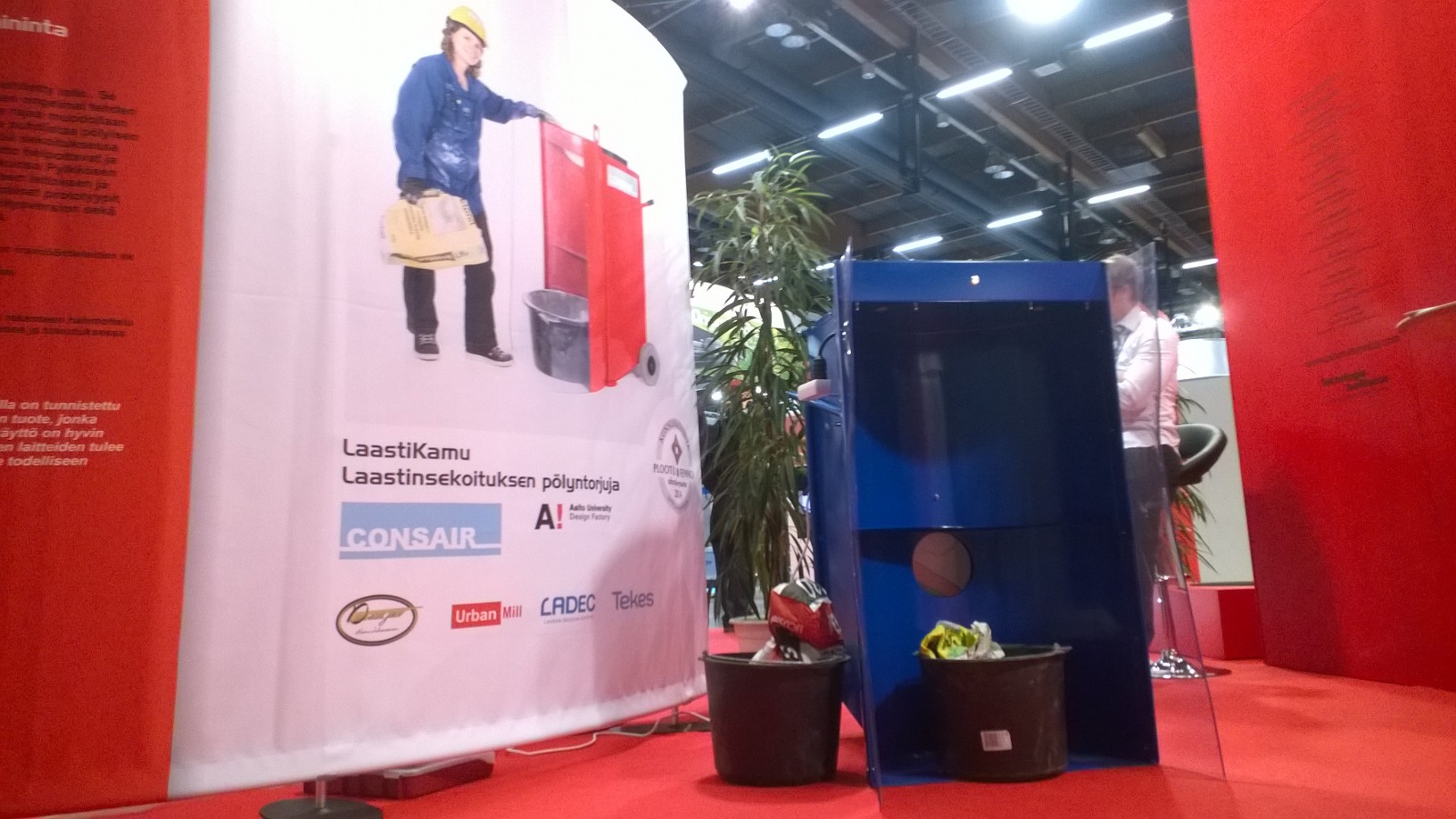
Kunniamaininta: LaastiKamu – Laastin sekoituksen pölyntorjuja

LaastiKamu on rakennusteollisuuden pölyntorjuntaan kehitetty laite. Se ratkaisee työmaiden pölyisimmän työn eli laastinsekoituksen ongelmat tehden työstä siistimpää, terveellisempää ja tehokkaampaa. Laite rajaa muodollaan laastinsekoitusastian ympärille osittain suljetun ilmatilan, ja puhdistaa pölyisen ilman suodattimensa avulla. Laite myös suojaa ympäristöä sekoituksessa syntyviltä roiskeilta. Laitteen valaisin sekä sähkön ulosotto helpottavat ja nopeuttavat työntekijän työsuoritusta. LaastiKamu sai alkunsa
Pylkkösen Helsingin yliopiston kemian laitokselle yhdessä Ilmatieteen laitoksen ja Skanskan kanssa tekemästä opinnäytteestä 2011. Ensimmäiset prototyypit valmistettiin 2012 keväällä. Nykyinen malli on noin 10 kehitysversion sekä useiden työmaa- ja laboratoriotestien tulos. Urban Mill on tarjonnut Laastikamulle testaus- ja protoilu- ympäristön.

LaastiKamu2014 Fintec 6.5.2014

Tuomaristo kiittää: ”Olemassa oleva todellinen ja suuri ongelma
rakennustyömailla on tunnistettu ja poistettu kehittämällä yksinkertainen ja helppokäyttöinen tuote, jonka valmistuksessa on käytetty ohutlevytekniikkaa.
Ohutlevyn käyttö on hyvin perusteltua tämäntyyppisissä ympäristöissä, joissa liikuteltavien
laitteiden tulee kestää monenlaista käsittelyä. LaastiKamu on älykäs tuote todelliseen tarpeeseen!”

Tiimi ja tukijat:

Pekka Pylkkönen, Consair Oy / Aalto-yliopisto
Frank Russi, Consair Oy / Aalto-yliopisto
Jarno Silen, Consair Oy / KEUDA-ammattiopisto
Juha Silen, Consair Oy / Kuusitunturi Oy
Heino Jukarainen, Design Heino Jukarainen

Aalto-yliopiston Design Factory, UrbanMill,
LADEC Oy, ELY-keskus ja Tekes

________________________________________________________________________

Plootu Fennica Sheet Metal Product Design Competition has ended. Urban Mill pioneers Juho-Pekka Virtanen, Pekka Pylkkönen ja Frank Russi from Aalto University were awarded.


Sheet metal product of the year was announced and the prizes were awarded at the FinnTec 2014 Fair in Helsinki at Helsinki Messukeskus, Expo and Convention Center. All awarded works will be impressively displayed at the Plootu Fennica stand. We warmly welcome visistors to Helsinki Messukeskus, Expo and Convention Center. Awarded works are on display throughout the fair from May 6 to 8, 2014.

We look forward to seeing you at the fair!

Plootu Fennica sheet metal product competition is open to all with a product or part of a product designed and manufactured of sheet metal. The competition is divided into three equivalent categories: industrial, design, and educational establishments. The winner of each category is awarded with a cash prize. In addition to winning prizes and honorable mentions, the competition provides publicity and visibility at FinnTec Fair and in the press.


Welcome to the Product Design Gala 16.5.2014!

Are business, design, engineering or innovations close to your heart?
Would you be interested to see what an interdisciplinary team can
accomplish in a year together with industry partners and university
mentors?

We welcome you to fall in love with the results of our interdisciplinary Product Development Project -teams in the Product Design Gala on

Friday 16.5.2014
Exhibition open 9:00-17:00
Aalto Design Factory & Urban Mill
Betonimiehenkuja 5 C & 3 E Otaniemi, Espoo

The student teams from Aalto University have been working hard for
the whole year to complete their design challenges given by industrial
companies and other collaborating parties. In the public exhibition
you’ll have the possibility to get familiar with the teams as well as with
their amazing prototypes.

This year the teams were sponsored by the following companies:
ABB Marine, FIMA, Genano, KONE, Nokia, Norpe, Philips, RAY, SAKO,
Vaisala and Wärtsilä. In addition student team, Bed Bug Kill, is working
on their own idea and another team is collaborating with the New
Children’s Hospital-project.

Schedule
09.00 Doors open – the exhibition starts!
13.00 Selected presentations @Stage
17.00 The exhibition ends

More details concerning the Gala and this year’s projects:

What is PdP?

PDP Gaala 2014 Press Release

See you in Gala!

Professor Kalevi “Eetu” Ekman & the whole PdP-crew
All you need is Love, Design, Business and Engineering!